
FEATURE STORY
Growing a Garden of Academic Excellence
His path to USC from China led the clinician-scientist through resilience and growth — and now the Ostrow Dean will nurture learning, patient care and research into the future.
BY KATHARINE GAMMON
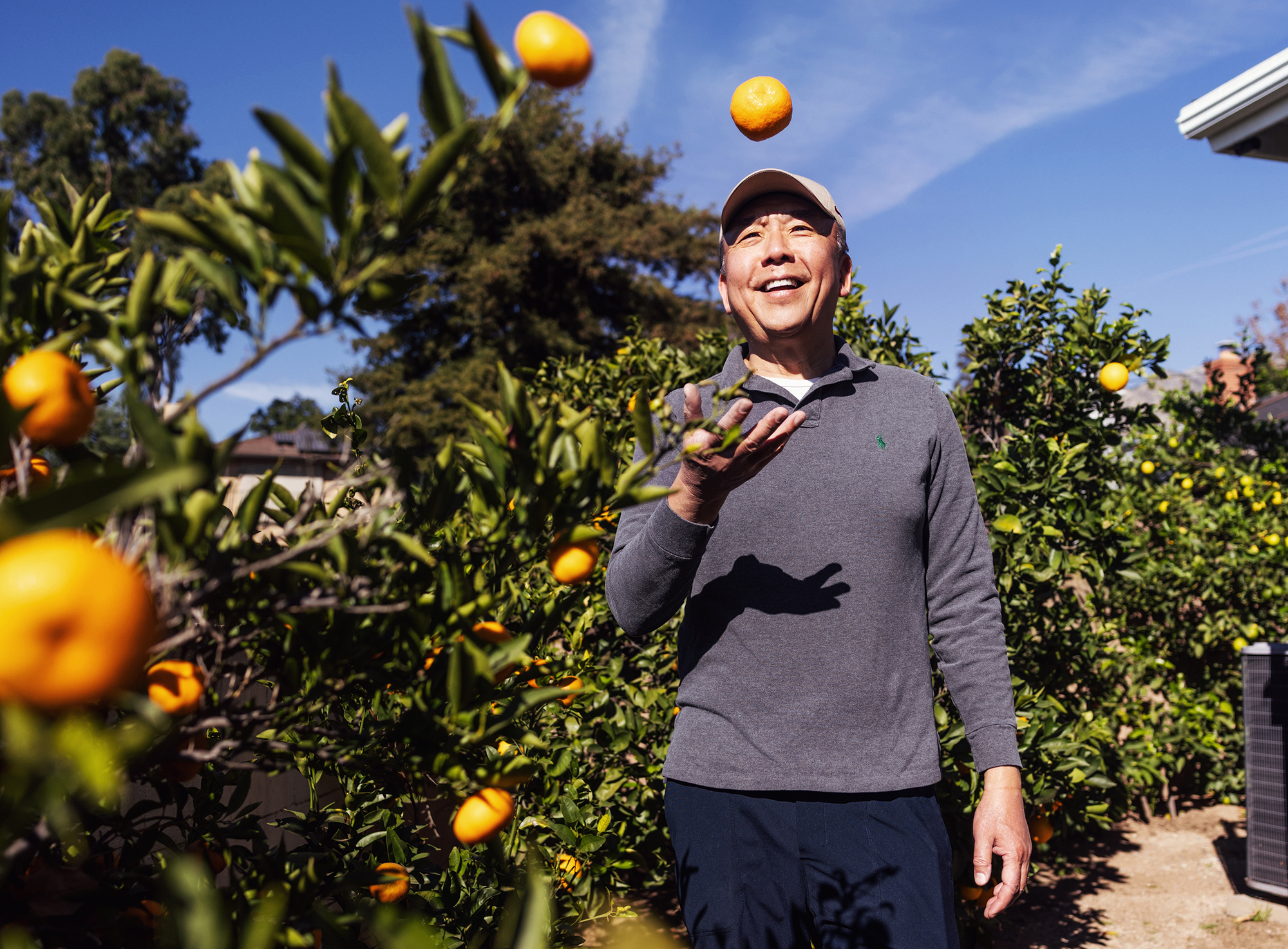
ON SUNDAYS, Ostrow’s very busy Dean, Yang Chai PhD ’91, DDS ’96, can be found doing something far from working with stem cells or students. With his hands covered in the dirt of the garden outside his home in Los Angeles, he’s thinking about vegetables, flowers and fruit trees. He feels peaceful among the persimmons, pomegranates and the citrus fruits that are just starting to get big this time of year.
“I love working outside,” Chai says. “I do a lot of yard and gardening work and enjoy building things in the yard.”
After more than three decades of pioneering groundbreaking research and hundreds of peer-reviewed publications, Chai was officially appointed Dean of the Herman Ostrow School of Dentistry of USC in July 2025.
And like his garden, he’s been planting seeds and cultivating the success of the school for decades, slowly and methodically working to bring people and programs together. In his own telling, it’s a labor of love — as well as passion, resilience and collaboration — to see academic success blossom.
Drawn to the Magic of Medicine
Chai was born and raised in Beijing China, in what was then called Peking — he and his family lived in the residential neighborhood close to the Forbidden City in the center of the metropolis. His was a family of medical professionals and educators — Chai’s maternal grandfather received medical training in Chicago in the early 1930s, before returning to China, where he became the first person to perform open-chest surgery in the country.
When Chai was just 5 years old, he went to live with his grandmother, who worked as a nurse. The young boy spent long days on the hospital ward, just playing and observing the adults around him. To a young child, there was something almost magical about watching patients improve with good care. “You can see how patients come in, get treated, and they get better,” he recalls.
As he spent years hanging around the hospital, Chai found himself drawn to the human face. “I always felt the human face is our identity,” he says. “I really was drawn to the magic of medicine.”
When it came time to apply to college, Chai felt his path was clear: He wanted to follow in his family’s footsteps in the health professions. He went on to earn his degree from Peking University School of Stomatology. It was there that he specialized in oral and maxillofacial surgery — a result of his fascination with faces. It was a defining moment, he says: He was treating kids with craniofacial birth defects like cleft lip and cleft palate. Weary parents would always ask him two questions: Why did my child get this? and then, If we have another child, will this happen again?
Chai didn’t have the answers, and it weighed on him not to be able to fully explain the causes of cleft palate. “Back then, we didn’t know as much as we do today about the cause of these congenital birth defects,” he says. “Those questions really changed me.”
Following His Heart
He knew that he had to learn more. So knowing “basically nothing” about Los Angeles, he applied to graduate school at USC — specifically because he knew it had one of the longest-running craniofacial doctoral programs.
Shortly before departing from China, Chai married his then-fiancée Lihua Liu, who had received a fellowship from the United Nations to study in USC’s master’s program in applied demography. Later, Liu continued her education at USC and received her PhD degree in demography and medical sociology. Today, she is an associate professor of clinical population and public health sciences and spatial sciences with dual appointments at the Keck School of Medicine of USC and the USC Dornsife College of Letters, Arts and Sciences.
After receiving his PhD degree in 1991, Chai completed his postdoctoral training at the Center for Craniofacial Molecular Biology (CCMB) and received his DDS degree and license to practice dentistry in the United States. Chai started as a tenure-track assistant professor at USC in 1996. He and Liu were planting roots.
Since then, Chai followed his heart and cultivated his research in craniofacial development and has been continuously funded by the National Institutes of Health at CCMB for nearly three decades — even as he took on administrative roles, raised two daughters (also USC alumnae), taught courses and mentored students.
“I’m very, very grateful to be able to do this research and get a better understanding about what causes craniofacial birth defects,” Chai says. “Now, with stem cells and tissue regeneration, we’re really getting close to some therapies that can help patients to get better treatment outcomes.”
Between his wife, two daughters and Chai himself, the family holds eight degrees from USC. That makes the university feel like home in so many ways — professionally, socially, culturally and academically. “USC has been so good to us. As we developed our careers, we have met such inspiring and smart people who are great colleagues,” he says. “I just feel like the university has been a place for me to grow, for me to learn and then a place to give back.”
Making Things Better for Others
One way that Chai has been able to give back is by growing CCMB and the school’s research program. He says that the school has nearly tripled its research funding in the past years, contributing to Ostrow’s latest ranking as the nation’s second highest-funded dental school by the National Institutes of Dental and Craniofacial Research. “Now serving as the Dean of Ostrow, I get to help our school to continue our 128 years of legacy in education, clinical excellence, patient care, research and community outreach” he says.
Ostrow also houses the USC Chan Division of Occupational Science and Occupational Therapy and the USC Division of Biokinesiology and Physical Therapy — both top-ranked programs in the country — which has spurred some interesting interdisciplinary collaborations.
Chai points to a pediatric dentist who worked with occupational therapists to modify the treatment environment to provide treatment for kids with developmental disorders as an example of the ways that different tracks work in harmony, making better opportunities for all patients.
To students, he has some advice: “Be passionate about what you do, continue to stay curious, and don’t be afraid to make mistakes,” he says. “Rejections are OK, as long as you can learn from them and keep trying. They are often the moments that teach you the most about yourself — about resilience, humility and the importance of persistence.”
Chai’s garden is full of the fruit he’s nurtured, and likewise, his research and professional career is blooming with opportunities. Through it all, he stays humble — and curious. “We’re all here for a very finite amount of time,” he says, “and we just want to make things better for others.”
DEAN’S LIST
After a year as Interim Dean — and more than three decades as a Trojan dentistry community member — Yang Chai recently took the reins at Ostrow. As part of that year in the interim status, Chai spent a lot of time talking with the community to get their feedback about the direction of the school. “I truly believe that the most important thing for a leader is you first have to be a good listener,” Chai says. After listening to that community feedback, here are some of Chai’s priorities moving forward:
EDUCATION
▶ Continue strengthening our educational programs, focusing on academic excellence.
▶ Incorporate artificial intelligence, machine learning and digital workflows into educational programs.
▶ Continue growing our scholarship endowment to ease the financial burden associated with seeking an advanced healthcare degree.
▶ Regularly offer faculty members opportunities for professional development and continuing education.
PATIENT CARE
▶ Develop and implement precision health care through collaboration with the medical care system.
▶ Continue to grow our community outreach efforts to expand collaborations with schools, healthcare systems and organized dentistry.
RESEARCH
▶ Recruit even more clinician-scientists focused on translational research.
▶ Find ways to embark upon cross-school and cross-disciplinary research to develop new collaborative programs that will propel us in new directions in prevention, diagnosis and treatment.
FUNDRAISING
▶ Develop and strengthen corporate and industry partnerships to be able to translate our discoveries into a new gold standard of patient care.