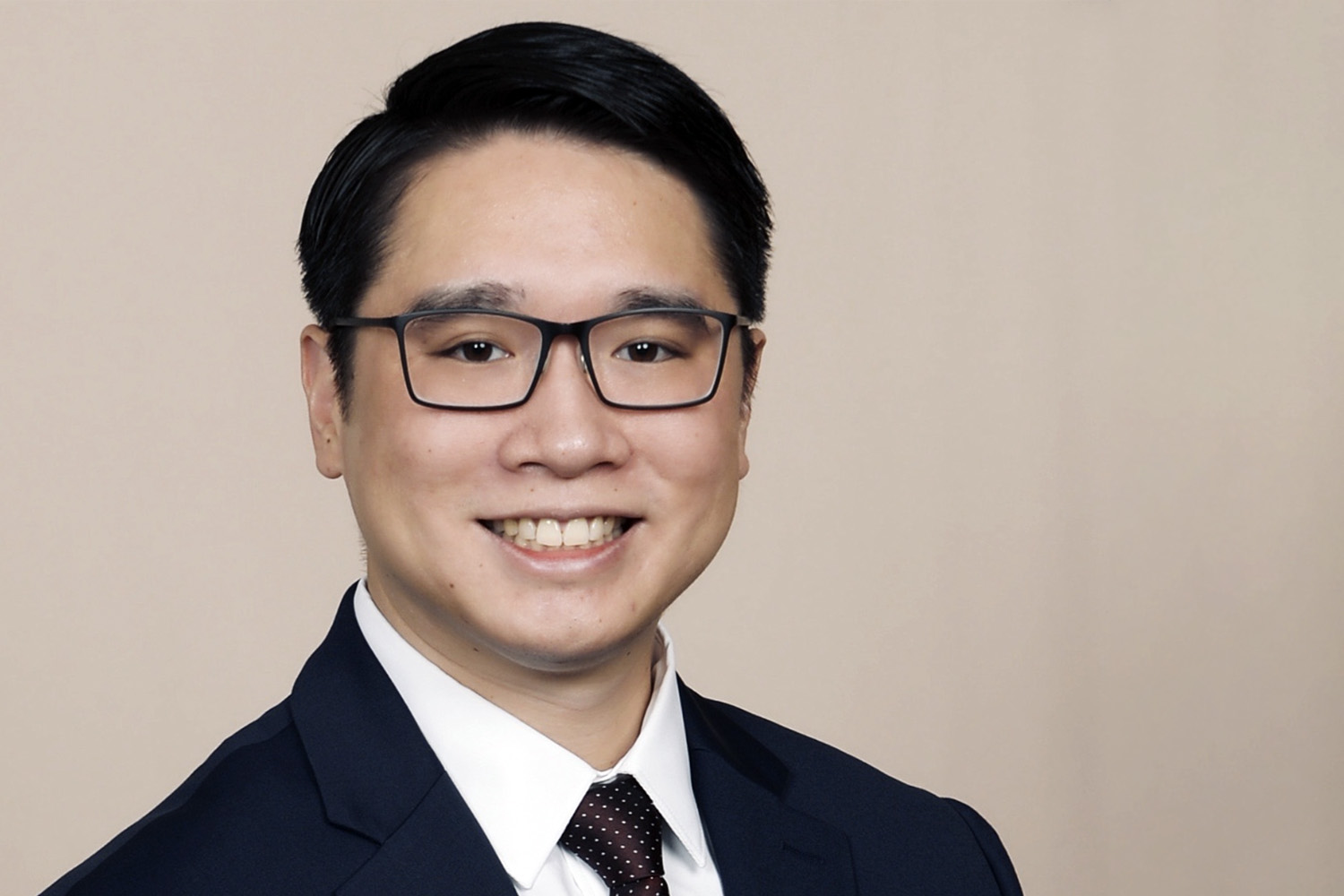
Joining the oral and maxillofacial surgery department earlier this summer, Jeffrey Tsai aims to focus not only on educating residents and students about proper technique but also the softer skills of ethics, compassion and interdisciplinary collaboration.
JEFFREY TSAI HAS ALWAYS BEEN DRAWN to tackling the toughest cases. He enjoys the pace of the operating room, especially with the complexity of cases that involve facial trauma. Tsai recently joined Ostrow’s faculty, serving in the oral and maxillofacial surgery division, with a clear goal in mind: to teach future surgeons while helping expand care for patients with complex surgical needs.
Tsai’s interest in dentistry began early. His father was an orthodontist, and Tsai knew he wanted to work in the dental field. But it was a research year during dental school that helped him identify oral and maxillofacial surgery as his specialty.
Between his third and fourth years of dental school, Tsai conducted research at the National Institutes of Health on craniofacial bone development. While there, he met and shadowed oral and maxillofacial surgeons.
The field’s range — from trauma and pathology to outpatient sedation — appealed to him. “It just really struck,” Tsai says. “The variety of what oral surgeons can do was very exciting to me at the time as a student.”
After completing residency at the University of Washington in 2019, Tsai worked for a year in private practice in Los Angeles, followed by five years at the Department of Veterans Affairs in Los Angeles. At the VA,
Tsai taught residents and dental students while treating veterans, an experience he described as rewarding. Still, he wanted more exposure to complex operating-room cases.
An unbeatable environment
To build that experience, Tsai completed a fellowship in St. Louis focused on facial trauma and surgery on the temporomandibular joint (TMJ). The fellowship reignited his interest in larger and more complicated surgical cases, and helped lead him back to Los Angeles, where his family lives.
“USC just seemed to provide that kind of environment that I was looking for,” he says. “I could teach residents, I could teach students, I’d be in an academic environment where I could collaborate with researchers and other divisions in the school.”
At USC, Tsai says his first priority is education. He hopes to train residents and students who are not only technically capable but also guided by ethical and compassionate care. He also hopes to develop more surgical options for patients with TMJ disease, a group he believes may not have many available treatment choices in the region. Tsai sees an opportunity to serve a community need through specialized TMJ surgical care.
The variation within oral and maxillofacial surgery remains a central source of motivation. One day, he may be treating patients in the clinic, providing sedation and performing minor procedures. Another, he may be in the hospital caring for patients with serious surgical needs. “That variation is what keeps me going,” Tsai says.
Tsai acknowledges that his career required years of demanding training and personal sacrifice. He and his wife, who also works in health care, were long-distance during much of his training. But he said the effort was worthwhile. “When I look back on it, all those years and all those busy times went by in a flash,” he says. “I have a lot of rich experiences to look back on.”
For Tsai, success will ultimately be measured by the impact of the people he teaches: residents and dental students who go on to make lasting contributions in their own communities.